Neighborhood Guides
Eastside School Districts Compared: BSD, LWSD, ISD, and Northshore — The 2026 Relocation Intel Guide
May 12, 2026 · 15 min read

By Adriano Tori
Founder & Designated Broker, RexMont Real Estate
WA Lic. #27660
Seattle & Eastside Real Estate Market Strategist
★ BusinessRate Best of Bellevue 2025
★★★★★ 1,235 Google reviews · Seattle and the Eastside's most-reviewed brokerage
Test scores alone won't tell you which Eastside district is right for your family — or which streets put you in the boundary that matters. RexMont's 2026 guide covers BSD vs. LWSD for tech families, the Choice school lottery trap, HiCap programs by district, how a single street-level boundary line moves home prices by $50K–$150K, and the resale math for buyers without children.
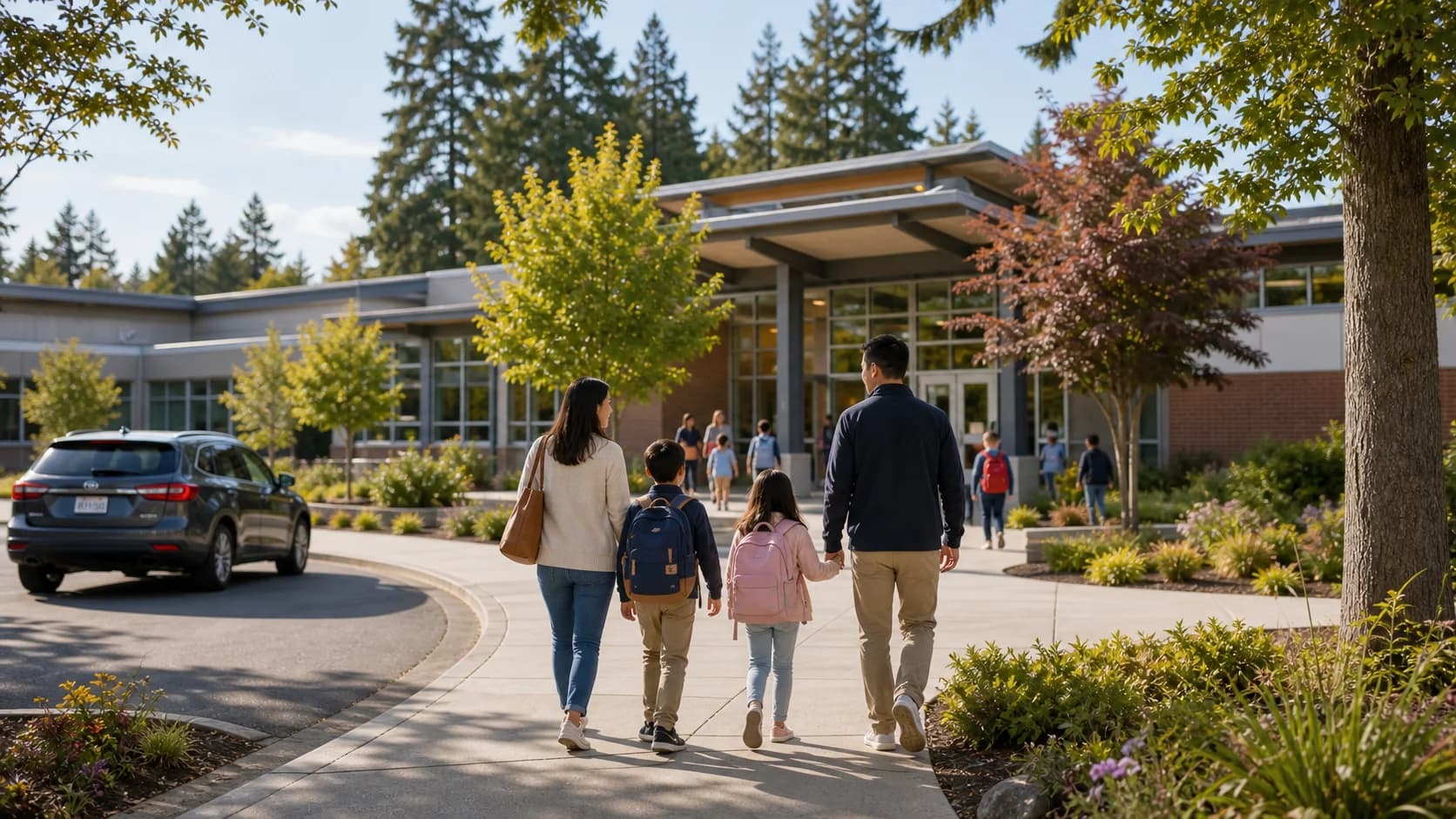
Why school districts drive Eastside home prices more than any other single factor
On the Eastside, school district assignment is not a feature of a home — it is a pricing variable that can move the value of otherwise identical properties by $50,000–$200,000. Families narrowing their search to specific districts, and sometimes to specific elementary school boundaries within a district, create concentrated demand zones that drive prices independent of any other neighborhood characteristic.
The four major Eastside districts — Bellevue School District (BSD), Lake Washington School District (LWSD), Issaquah School District (ISD), and Northshore School District — each command distinct real estate premiums. Understanding those premiums, what drives them, and where the value gaps exist is foundational knowledge for any Eastside home search, regardless of whether you have school-age children.
Even buyers without children benefit from understanding district premiums. BSD and LWSD address lists will have systematically larger buyer pools at resale than comparable properties in lower-tier districts — a factor that affects long-term appreciation trajectories and days-on-market when you eventually sell. Buying in a strong district is an equity insurance policy that costs nothing extra in the purchase price if you buy it right.
What separates an experienced Eastside agent from a generic one is not knowing which district has the highest test scores — anyone can look that up on GreatSchools.org. It's knowing which streets mark the boundary between BSD and LWSD in a given neighborhood, which Choice school lotteries are genuinely realistic, and whether a specific address is at risk of redistricting. That knowledge is worth more than any ranking table.
Bellevue School District: the premium tier and what actually drives it
Bellevue School District (BSD) is consistently ranked among the top public school districts in Washington State and is one of the most academically competitive public districts in the country. The district's high schools — Bellevue, Newport, Sammamish, and the International School — are nationally recognized for college preparation, STEM programming, and academic rigor. BSD graduates are disproportionately represented in selective university admissions, and this outcome data is what sustains the district's premium over time.
The BSD premium is real, substantial, and geography-dependent. West Bellevue neighborhoods (Medina, Clyde Hill, West Bellevue proper) carry the highest BSD premium because they combine the district's academic reputation with proximity to Seattle employment and waterfront access — three separate value drivers that compound. East Bellevue neighborhoods (Somerset, Newport Hills, Factoria, Eastgate) carry a meaningful but lower BSD premium because the commute to Seattle and the lifestyle amenity picture is different.
What most buyers don't know about BSD: the district has 'Choice schools' — specialized programs that admit students by lottery rather than geography. The International School (K–8 international curriculum) and Jing Mei Elementary (Mandarin immersion program) are the most sought-after. Living in BSD gives your child lottery eligibility — but does not guarantee a seat. We regularly work with families who moved to BSD specifically to try for the International School and did not get in. If a specific Choice program is the primary motivation for moving to BSD, have a clear backup plan for what school your child attends if the lottery doesn't go your way. The backup school still matters.
BSD's Highly Capable (HiCap) program serves academically accelerated students and is one of the strongest in the state. HiCap cohort programs concentrate gifted students in dedicated classes at specific schools; acceptance requires district evaluation and qualification. If a HiCap placement is a priority for your family, verify which BSD schools have current cohort programs — the specific schools have shifted as the district has made enrollment adjustments — and ask your agent which addresses put you closest to those specific buildings.
Key BSD geographic areas: West Bellevue, Medina, Clyde Hill, Beaux Arts, East Bellevue (Somerset, Newport Hills, Cougar Mountain corridor), parts of Lakemont (verify specific parcels — some Lakemont addresses fall in BSD, some in LWSD). Always verify address-level school assignments through the district website, not through listing agent representations.
Lake Washington School District: the tech-family district for Kirkland and Redmond
Lake Washington School District (LWSD) serves Kirkland and Redmond and has built its reputation on tech-sector-aligned programming, strong STEM curriculum, and consistently high academic outcomes. The district's high schools — Juanita, Lake Washington, Eastlake, Redmond, and others — are well-regarded both regionally and nationally. LWSD has made deliberate investments in the programming areas that matter to its Microsoft, Google, and Amazon family base: robotics, computer science, dual-credit programs, and IB pathways.
LWSD's premium is substantial but typically runs below BSD by a measurable margin — the gap reflects BSD's longer prestige history and the additional value drivers (Seattle proximity, waterfront access) in BSD neighborhoods, not an objective quality gap proportional to price. For families who prioritize STEM focus and tech-culture alignment over prestige branding, LWSD delivers comparable outcomes at a lower home price.
Tesla STEM High School in Redmond is one of LWSD's most significant draws for tech-sector families. It is a specialized competitive-admissions STEM high school that draws highly motivated students from across the district — and the residential addresses within the Tesla STEM attendance zone carry a documented premium over nearby LWSD addresses outside that zone. If Tesla STEM is part of your family's school plan, understand that it requires competitive application and is not guaranteed by address — but living in the attendance zone gives your child in-district priority status.
LWSD has robust HiCap programs at the elementary and middle school level. The district's HiCap pathways include both self-contained cohort programs and differentiated instruction models depending on the school. As with BSD, specific program placements shift with enrollment — verify current HiCap school assignments directly with LWSD rather than relying on information that may be a cycle or two out of date.
Key LWSD geographic areas: Kirkland (central, Juanita, Houghton, Rose Hill, Finn Hill — some Finn Hill addresses are LWSD, some are Northshore SD), Redmond (most of the city), and parts of Sammamish and Kenmore (boundary areas — always verify).
Issaquah School District: the best value-to-quality ratio on the Eastside
Issaquah School District (ISD) consistently ranks among the top public school districts in Washington State and delivers academic outcomes that are competitive with LWSD on nearly every measurable dimension — at Issaquah home prices that typically run $100K–$300K below comparable LWSD or BSD inventory. For families whose primary concern is academic quality and who have flexibility on commute, ISD represents the most compelling value proposition in the Eastside market.
ISD's high schools — Issaquah High, Liberty High, and Skyline High — all perform strongly on state assessments and college admissions metrics. Liberty High School has a well-regarded International Baccalaureate (IB) program that draws academically motivated students from across the district. For families seeking a rigorous academic environment with an IB pathway, Liberty's program is as strong as anything in LWSD or BSD.
ISD has HiCap programs at multiple schools throughout the district. Clarification Creek Elementary and other schools have hosted HiCap cohort programs; specific program locations shift with enrollment changes. If HiCap placement is a priority, contact ISD directly for current program locations and qualification processes — the programs are real and well-supported, but the specific schools hosting cohorts change more frequently than most district marketing materials reflect.
The ISD value gap versus BSD is particularly compelling in one specific scenario: a family that qualifies for and intends to use private school for high school. If you plan to send your children to Overlake School, Eastside Preparatory School, or another private high school regardless of district assignment, paying the BSD or LWSD real estate premium for public high school access may not be rational — and Issaquah neighborhoods with ISD access at lower price points become the obvious choice.
Key ISD geographic areas: Issaquah city proper, Issaquah Highlands, Talus, Sammamish plateau (the majority of Sammamish is ISD), Klahanie, and parts of east Sammamish. Skyline HS covers the central Sammamish plateau; Liberty HS covers east Sammamish and Issaquah Highlands; Issaquah HS covers south and central Issaquah.
Northshore School District: north Eastside's strong option
Northshore School District serves Bothell, Kenmore, Woodinville, and parts of north Kirkland (some Finn Hill and Juanita addresses — the boundary with LWSD is specific and not intuitive). The district has a strong academic reputation, particularly for its high schools — Bothell, Inglemoor, and Woodinville High — and is consistently competitive with LWSD on state assessment metrics.
Northshore's real estate premium is real but typically the lowest of the four major Eastside districts. This creates a genuine value opportunity: strong school quality at the lowest price points on the Eastside. For buyers whose budget is stretched by Kirkland or Bellevue pricing and whose geographic flexibility extends to Bothell, Kenmore, or Woodinville, Northshore is often the answer.
Einstein Elementary within Northshore SD has historically hosted one of the region's better-regarded elementary HiCap programs. Northshore's overall HiCap offering is less prominent than BSD or LWSD's, but the programs exist and are worth asking about if this is a priority for your family.
Woodinville specifically is worth calling out as an undervalued combination. Woodinville High School under Northshore has a strong academic profile, Woodinville's vineyard and outdoor lifestyle character is unique on the Eastside, and the combination of school quality plus lifestyle premium at Northshore price points is a compelling package that many buyers overlook because they anchor on Kirkland or Bellevue as the default tech-family destination.
The LWSD/Northshore boundary in Finn Hill is a real source of buyer confusion. Some Finn Hill addresses are LWSD (feeding to LWSD high schools), and some are Northshore (feeding to Northshore high schools). The school assignment can differ by a single street in Finn Hill. Always verify the specific parcel before making an offer.
The Choice school and HiCap reality: what district assignment actually guarantees
A common and expensive misunderstanding among incoming Eastside buyers: living in a school district does not guarantee a seat in that district's most sought-after programs. BSD's International School, Jing Mei Elementary (Mandarin immersion), and other Choice programs admit students by lottery. LWSD's Tesla STEM High School admits by competitive application. These programs are not automatic benefits of living in the district — they are opportunities you can apply for.
We regularly work with families who relocated to BSD primarily to access the International School lottery and did not receive a placement. The family paid a BSD premium for a program they didn't get, and their child now attends a neighborhood school that is excellent but not the specific program they moved for. This is not a failure of BSD — it is a planning failure that an experienced agent should help buyers avoid. If a specific Choice program is the driving motivation, understand the odds, have a backup school plan, and verify whether the backup school's profile still justifies the premium before committing.
Highly Capable (HiCap) programs are the other major category where families make geography decisions without full information. HiCap qualifying students receive priority placement in cohort programs — but the specific schools hosting those cohorts change over time as enrollment shifts and district planning evolves. If HiCap is a priority, verify current cohort locations directly with each district rather than relying on information from previous years or third-party school rating websites. RexMont stays in active contact with district enrollment staff specifically to advise clients on these program locations.
Boundary fluidity is a real risk that buyers frequently underweight. All four major Eastside districts have adjusted attendance boundaries as their cities have grown. A home that is currently in a desirable school's boundary may not stay there through your child's entire school career. Paying a premium for a specific elementary school boundary with a 12-year time horizon is a different calculation than paying for a high school boundary with a 4-year horizon. Ask your agent what the redistricting history is for the specific address you're targeting — and ask the district directly whether there are any announced or pending boundary changes.
How school boundaries affect home prices: the street-level premium
The most important thing to understand about school-district premiums is that they are not city-level or neighborhood-level — they are street-level. A single boundary line can separate two otherwise identical homes by $50,000–$150,000 in market value, because the family buyer pool for those two homes is fundamentally different.
The BSD/LWSD boundary in the Lakemont area is the clearest example on the Eastside. Homes on one side of a specific street qualify for BSD; homes two properties away qualify for LWSD. Both sets of homes look identical in photos. The price difference reflects nothing about the physical home — it reflects which family buyers can and cannot purchase each home given their school priority.
High-performing elementary school boundaries within districts create sub-premiums on top of district premiums. Within BSD, addresses that feed to Medina or Enatai Elementary carry premiums over other BSD addresses because those specific schools have academic reputations that matter to a segment of buyers even within an already-premium district. Within LWSD, addresses in the Tesla STEM attendance zone carry a premium over other LWSD addresses. These sub-district premiums are real, persistent, and not captured in automated valuations.
The practical implication for buyers: when evaluating comparable sales in a neighborhood that straddles a school district boundary or a significant intra-district school boundary, your agent needs to flag which comps are in which school zone. A comp analysis that blends across a significant boundary is not a valid comp analysis — it's averaging two different products. This is one of the most common pricing errors we see in Eastside transactions, and it consistently produces mispriced offers in both directions.
Private school options and how they factor into home search geography
A meaningful share of high-intent Eastside buyers are considering private school at some point in their children's education — and for these buyers, proximity to private campuses is a real factor in their home search geography, sometimes independent of public district assignment.
The major Eastside private schools worth knowing: Overlake School (Redmond, grades 5–12) consistently ranks among the top private schools in the Pacific Northwest — families who are committed to Overlake tend to concentrate in Redmond and east Kirkland to minimize school-day travel. Eastside Preparatory School (EPS) in Kirkland offers K–12 and draws from across the Eastside; Kirkland and Juanita addresses give you a short commute to both EPS and Overlake. Bellevue Christian School has multiple campuses and serves families seeking faith-integrated education with strong academics.
Forest Ridge School of the Sacred Heart in Bellevue is an all-girls K–12 with a strong IB program that draws from across the Eastside and Seattle. Lakeside School in north Seattle serves the high-income buyer segment that bridges Eastside and Seattle — families who consider Lakeside often look at Medina, Clyde Hill, and Laurelhurst simultaneously.
The practical implication: if private school is in your plan for your child's high school years, buying in BSD primarily for BSD high school access may be paying for a program you'll exit. In that scenario, ISD or LWSD neighborhoods at lower price points — combined with a private school plan for the years that matter most to you — may produce a better financial outcome without sacrificing educational quality.
How to use this comparison in your home search
If schools are your primary filter, start with this decision tree: BSD if maximum school prestige, Choice school opportunity, or west Bellevue lifestyle is the priority and budget supports the premium. LWSD if tech-sector lifestyle alignment, Kirkland or Redmond geography, or Tesla STEM access is the goal. ISD if academic quality matters most but budget flexibility is limited and hybrid work makes an Issaquah commute acceptable. Northshore if north Eastside geography works and school quality at the lowest price point is the calculation.
Price the school premium explicitly before you commit. Ask your agent to run comparable sales for similar homes on both sides of any significant district boundary in your target area. Know what BSD costs over LWSD in your specific search zone, and what LWSD costs over ISD. Then decide consciously whether that premium is worth it for your specific school plan — not just in the abstract, but for the specific schools your children would attend.
Verify every school assignment at the parcel level, not the neighborhood level. Use the specific district's enrollment tool (BSD: bsd405.org, LWSD: lwsd.org, ISD: issaquah.wednet.edu, Northshore: nsd.org) and cross-reference with the King County Parcel Viewer. Do this before making an offer, not after. School assignment errors by listing agents are common and often not caught until after close — at which point you own a home in the wrong district.
For buyers without school-age children: buy in BSD or LWSD if your budget supports it. The family buyer pool that these districts attract at resale is the deepest and most persistent buyer pool in the Eastside market — it produces faster sales and stronger price competition regardless of broader market conditions. School-district premium is the single most durable source of Eastside home value appreciation over the long term.
Frequently asked questions
- Which Eastside school district is best for STEM families?
- All four major Eastside districts have strong STEM programs, but they differ in emphasis and prestige. Bellevue SD has STEM programming at every school level and the International School for tech-focused families. Lake Washington SD has Tesla STEM High School (competitive admissions) in Redmond and has made the deepest investment in computer science and engineering curriculum at the district level — reflecting its Microsoft and Google family base. Issaquah SD's Liberty HS has a strong IB program with STEM depth. For families whose primary STEM goal is a rigorous high school STEM program, LWSD's Tesla STEM pathway is the most explicitly tech-focused option in the region. For families who want district-wide STEM consistency, BSD and LWSD are closest to equal.
- What is the best school district in Washington State?
- Bellevue School District is consistently ranked among the top two or three public school districts in Washington State by the Office of Superintendent of Public Instruction (OSPI) report card (reportcard.ospi.k12.wa.us) and by most third-party ranking methodologies. Lake Washington SD and Issaquah SD both rank in the top 5–10 statewide. Northshore ranks in the top 15–20. The honest answer is that BSD, LWSD, ISD, and Northshore all represent genuinely elite public school education — the differences between them are real but smaller than the price gap between their real estate premiums would suggest. The 'best' district depends on your specific child's needs, your family's school plan, and whether the premium is justified for your situation.
- How does buying in a top school district affect my home's resale value?
- School district assignment is one of the most durable drivers of Eastside home appreciation. BSD and LWSD neighborhoods consistently show stronger price competition at resale, faster days-on-market, and more resilient pricing during market softness than comparable properties in lower-tier districts — because the family buyer pool that strong districts attract is large, highly motivated, and persistent across market cycles. Even buyers without children typically find that BSD or LWSD addresses sell faster and with more multiple-offer competition than equivalent non-district homes. The premium you pay at purchase tends to be recovered and exceeded at resale because each subsequent buyer repeats the same district-driven purchasing decision.
- What is the Highly Capable (HiCap) program and which districts have it?
- Washington State law requires all school districts to identify and serve Highly Capable students — those who perform significantly above grade level and need differentiated instruction. On the Eastside, all four major districts have HiCap programs, but their structures and program locations differ. BSD has some of the most developed HiCap cohort programs in the state, with dedicated cohort classrooms at specific schools. LWSD has HiCap programs with both cohort and differentiated models. ISD and Northshore both have HiCap identification and service programs. Critically: the specific schools hosting cohort programs change over time as enrollment shifts. If HiCap is a priority, contact each district's enrollment office directly for current program locations rather than relying on websites or prior-year information.
- Can school district boundaries change after I buy my home?
- Yes — all four major Eastside districts have adjusted attendance boundaries as their cities have grown, and additional adjustments are possible. A home currently in a desirable school's attendance zone may be redistricted over a 5–10 year period, particularly in high-growth areas like Sammamish and Bothell where new development has forced enrollment rebalancing. The risk is highest for elementary school boundaries (long time horizon before your child ages out) and lowest for high school boundaries (shorter 4-year exposure). If school boundary assignment is a primary motivation for your purchase, ask your agent about the redistricting history for the specific address and contact the district directly about any announced or planned future adjustments. RexMont actively tracks district boundary news for our buyer clients specifically to provide this warning before it appears in public reporting.
Explore related pages
Talk to RexMont
Get a strategy session before you move.
RexMont is Seattle and the Eastside's most-reviewed brokerage — 1,235 five-star Google reviews, $1B+ closed. Our agents pair live market data with honest pricing, offer strategy, and negotiation guidance built for Seattle, Bellevue, and the Eastside.